Day Four
Kenilworth to Birmingham

11 from Kenilworth to Coventry
At the top of the hill, I saw the bus heading towards the stop. Oh well, there was no way I was going to get that, but buses to Coventry are two or three an hour. No big deal.
Then someone stepped out of the shelter and flagged down the bus. Here was my chance. In a very undignified manner, I started sprinting towards the stop. Having not done any running in more than twenty years, a sprint, even without the rucksack, for me is barely more than walking a bit faster than usual.
The bus waited, and I boarded.
Almost as soon as the bus left Kenilworth, we were in Coventry. Thirty minutes of leafy suburban villas suddenly made way to the bombed out city centre.

Coventry
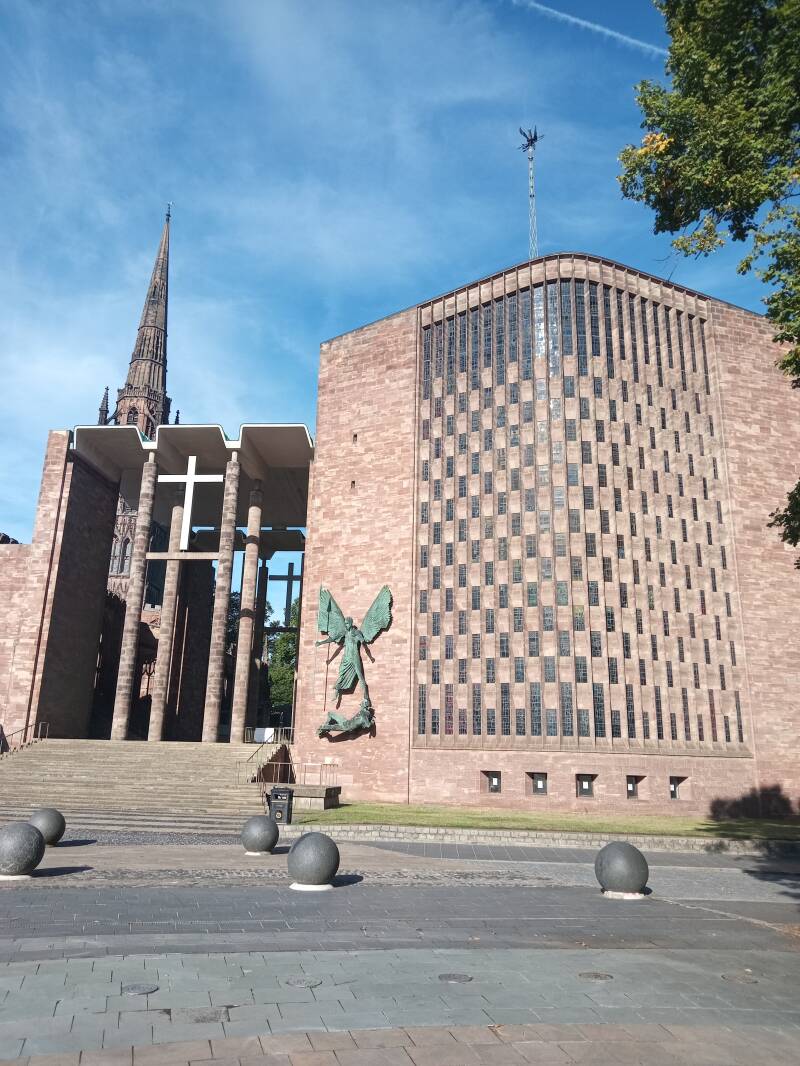


At its height, Coventry was the biggest and most important city in the Midlands. It developed into an important textiles centre, particularly making ribbons. In the 1860s, however, the industry went through a slump and never recovered, but gradually different industries took over.
Due to its manufacturing industry, the Nazis bombed the city, and much of it was destroyed in the Second World War. As such, ancient buildings stand amongst equally old ruins, and modernist structures. Despite the destruction, the city has tried to create pleasant open spaces and pedestrianised areas.
A statue of Lady Godiva on her horse watches over the main square in the city. The story is famous. In protest at her husband's plans to increase taxes, she rode naked through the city. For some reason, this convinced her husband to cancel his plans.
Coventry hasn't had a lot of luck with cathedrals, to be fair. Their first cathedral was the only one in English history to have been deliberately destroyed by the Church.
On the same site, their second cathedral was built. It went up in flames the first time Nazi pilots dropped bombs on the city.
The third cathedral was completed in the 1960s, with help from German volunteers. Citizens from Coventry also travelled to Dresden to help rebuild their bombed-out city.
The old cathedral is a strangely quiet memorial. In the south of England, cathedrals usually charge an entrance fee, so I was surprised that Coventry Cathedral does not. But I later found out that neither does Manchester Cathedral.
However, I was unable to visit as it was closed at the time I went that way.
The Herbert Museum is a shambles, but at five pounds, you don't really mind. You learn about the history of the city, and you get to see a plaster-cast replica of a dinosaur skeleton. What's not to love?
Mind you, several of the exhibits were closed, had been moved, or were occupied by early years teachers encouraging the toddlers in their care to sing.
X1 from Coventry to Birmingham
Coventry Bus Station is strange. It has a barber's, a doll repair shop, but only one cafe. I'd have thought if you're waiting for a bus, you'd want food, not to reattach a leg to your Barbie.
For the second time today, there also not a lot of countryside between Coventry and Birmingham. Having looked at maps for all of my life, I was already aware that the Midlands are more heavily populated than the south, but this trip is the first time I've really understood this on anything other than a fun fact level.
Once in the second city, the bus crawled painfully slowly through Solihull along the main road leading into the town centre.
An hour later, the urban sprawl finally made way for the skyline, and I was finally in the biggest city in the UK.
In case you're wondering why the UK's biggest city isn't London, the reason is that the capital does not have city status. The City of London does have city status, but is the second smallest city in England (after Wells, but there are several cities in Wales which are even smaller). Westminster also has city status, but has around a tenth of the population of Birmingham. No other part of London has city status!
I still had a coach ride to Manchester, but I had done just under two hundred kilometres (as the crow flies - my actual route is probably closer to three hundred kilometres) using only local buses. Let's be clear. These are buses that stop in every little village. Once they get into a city, they stop every two hundred metres - I had gone all the way from Bournemouth to Birmingham using only local buses!

Reflections on Reaching my Goal
I've reached my goal. I have travelled 180km as the crow flies from Bournemouth to Birmingham, and I only used local buses. It took my a few days when the train would have only taken a few hours.
But trains are usually built into embankments. Coaches usually just use motorways.
As ridiculous as this method of travel seems, it's actually really enjoyable.
My family have told me that I only did this trip because it's cheap, and I'm cheap.
Firstly, only I understand the motivation for this trip. On paper, it's very silly indeed, and I knew that before I forced myself to make this trip.
But more importantly, every bus costs £3. As getting from Bournemouth to Birmingham involves a lot of buses, I doubt four days on local buses is cheaper than the train.
But I'm glad I travelled this way. I saw so much of England. I don't think I'd have gone to Avebury Henge without this road trip. I certainly wouldn't have gone to Swindon or Coventry. I'd maybe not even gone to Birmingham or Manchester.
Birmingham
My first impression of the city was that it's big. I mean, really, really big. It had taken more than an hour to get from the airport into the centre. Like Coventry, Birmingham is also a strange mix of ancient architecture and modern skyscrapers, also because of extensive bombing during the Blitz. Like much of England, I wouldn't say it's a beautiful city, but I would say it has beautiful architecture.
I descended into a bustling market, and my first thought was where to buy a falafel wrap. This was not hard to find. As I was ordering, the owner of the food truck asked, "All veg and hot sauce?" I nodded. He handed me a ready-made wrap and said, "Someone ordered this ten minutes ago, and then disappeared. You might as well have it!"
I still had two hours before check-in, and so I went to the city museum and art gallery. This is a free museum, although they do ask you to make a donation. As the city is the birthplace of heavy metal, it's hardly surprising that Ozzy Osbourne gets a whole gallery to himself.
It's incredible to think that less than nine hundred years ago, only fifty people lived here. It was in 1166 that Peter de Bermingham obtained a licence to hold a market here. Traders flocked in from other villages, and the settlement started to grow.
Today, with a population of 1.2 million, Birmingham is the biggest city proper in the UK. London is, of course, bigger, but the city proper has a population of just 15,000, whilst the City of Westminster is also not a huge city. Manchester also has a bigger urban area, but the city proper is smaller.
The Balti Triangle was too far to go for dinner, but I found a South Indian restaurant not too far from the hotel. I got a vegetable thali - six dishes, and a plate of rice. It was quite a bit more than I wanted to eat, but the flavours were wonderful. Every dish was spiced with a different mix, but they all complemented each other.
But it was spicy. I mean, I have very good spice tolerance, but this meal was challenging. In an enjoyable way, I hasten to add.
Birmingham has a great feel to it, but I really don't like this Schroedinger's weather that you seem to get north of Oxford. In Bournemouth, it's either hot, or it's cold. On a hot day, you go out in short-sleeves. On a cold day, you wear an overcoat. No problem. But in the Midlands, by the time you've put on your coat, it seems like it's sweltering again. By the time you've removed it, a Baltic wind blasts you.

Create Your Own Website With Webador