Day Five

Birmingham
West Midlands Police Museum
I didn't fancy breakfast at the restaurant, and after extensively browsing restaurants on the map, I found a Syrian cafe which looked good. Around the Bull Ring is very confusing, and it probably took me about fifteen minutes to get onto the right path, but once I was there, finding the cafe was no problem.
A breakfast of falafels, flatbread, and strong Arabic coffee made everything so much better anyway.
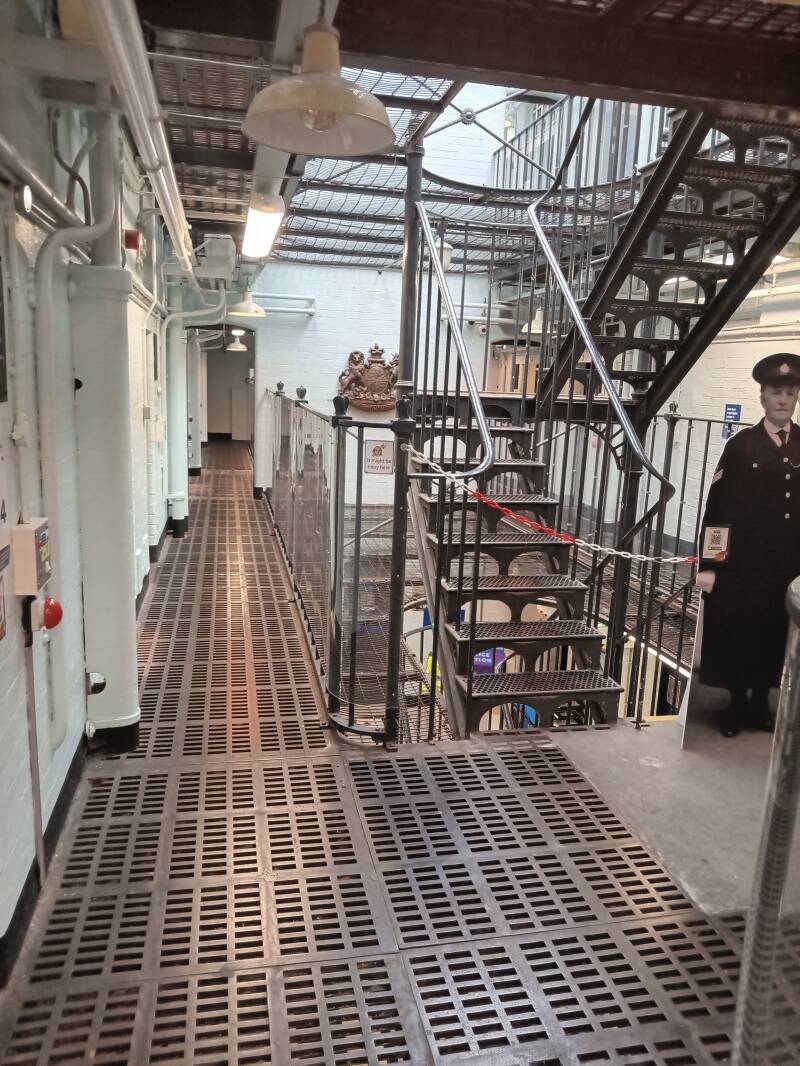
My first stop of the day was the West Midlands Police Museum. On the site of a former prison, the museum tells the story of crime and punishment through the ages. But mainly, it's a museum about law enforcement, and the day-to-day reality which police officers face.
Some very surprising facts I learnt include how recently people from ethnic minorities started to rise through the ranks to positions of power.
If there are four things that Birmingham is famous for, these would be Peaky Blinders, heavy metal, canals, and the Balti Triangle. I enjoyed the television series, and I have a Black Sabbath album or so, but I absolutely was not going to miss out on a canal-side walk, nor on a good curry.
The Canal


The towpath was quite dirty in parts, and I passed several people sleeping under bridges, or getting drunk, even at this early time in the morning.
I saw a barge waiting in a lock as the water level rose to allow the boat to continue on its journey. I had seen this before, but not since my teen years. I asked if I could watch, and the elderly couple who owned the barge graciously agreed. They told me that they'd travelled most of the navigable waterways in the UK, but that they did not live on the barge.
They also explained how locks work. Before locks were invented, the only way to take a barge upstream was to physically lift it up and carry it. Locks allow water from the upper part of the canal to flow to a lower section. This raises the water level in the lower section to the same level as in the higher section. And a rising tide raises all ships.
A little later, I met a volunteer from the Canal Trust. He told me that the canals were under threat of privatisation. This potentially meant that they would be closed, with the towpaths and surrounding area open to housing developments, and the recreational opportunities they currently provide people with ended forever.
Despite there being no canals in Bournemouth, or anywhere near, I became a friend of the canals - it would be a terrible shame if all of this was to disappear.
Tower blocks now overlook the canals, but in the past, the area was surrounded by factories. Most have closed down, but the legacy of their social and economic history is still very visible today.
Canals were invented by accident. Water filling open pits made further mining impossible. And so the water was pumped out, but it had to be pumped into something. And so the mining companies built long trenches to house the water.
Of course, it eventually seeped into the ground, but that took a long time.
The one bright spark thought about putting the coal on a boat, and transporting it along the trench inside of overland.
In the 18th century, engineer James Brindley was commissioned to build Birmingham's first canal. He would not be paid until the canal's completion. As a result, he built the canal according to the contours of the land, thus avoiding expensive tunnels and locks. During the construction of the canal, he fell into the water and caught pneumonia. He survived, but remained a sick man until his death - a day after the canal opened and he became a very wealthy man indeed.
The narrow waterways, which allowed only one barge to pass at a time, were frequent bones of contention. The term argy-bargy is a contraction of argument on a barge.
Taking this into consideration, Thomas Telford, who continued the project of building the canals, built wider waterways which allowed two barges to pass at the same time.
Apparently, several locations along the canal were used in Peaky Blinders, and I also snapped a mural of Ozzy Osbourne along the way, so by lunchtime, I had (technically) done three of the four iconic things to do in Birmingham.
The Balti Triangle
From the canal to the Balti Triangle is about an hour's walk. Despite the horrible weather, I decided to walk it.
I stopped off at at an old man pub on the way. And to confirm that it really was an old man pub, an old man walked in and asked how the young man was as he passed me.
This was a real traditional local pub where everyone knew everyone by name. I stayed for one pint - in a place like this, I feel like a bit of an impostor.
The story goes that some time in 1970s Birmingham a customer complained that his food was too dry. The chef, improvising, poured a tin of tomato soup into the plate and reheated it. And thus, the balti was born.
As well as Urdu, you hear a lot of Arabic in the district, and these days, many of the businesses are Middle Eastern, rather than Pakistani. There are also burger restaurants, sweet shops, and Turkish barbers.
But the sheer quantity of eateries along the four streets that make up the triangle is worth the visit, even if you have no intention of eating there.
I didn't get a balti. I'm not sure if I've ever had one, or even what it really is, but I figured that an actual balti on the Balti Triangle would probably be a tourist trap. Instead I went for an aloo palak. Spiced spinach and potatoes, it hit the spot, but the portion was a bit too generous for me to finish.

Create Your Own Website With Webador