
Day Three
Kenilworth
Kenilworth - St Mary's Abbey
It's rare that a town is just a(n) [insert stereotype].
I've lived in all three functional cities which claim to be the largest town in the UK without the status (Croydon, Luton, and Bournemouth), all three of which have terrible reputations.
OK, I was three when I left Croydon, so I really don't remember it. My parents have fond memories of it, though.
But growing up in Luton, I can assure you, it isn't just an airport, and my adopted home of Bournemouth is more than the beach.
Likewise, Kenilworth Castle is fascinating, but it's not the only show in town.
I started my day at the ruins of St Mary's Abbey.
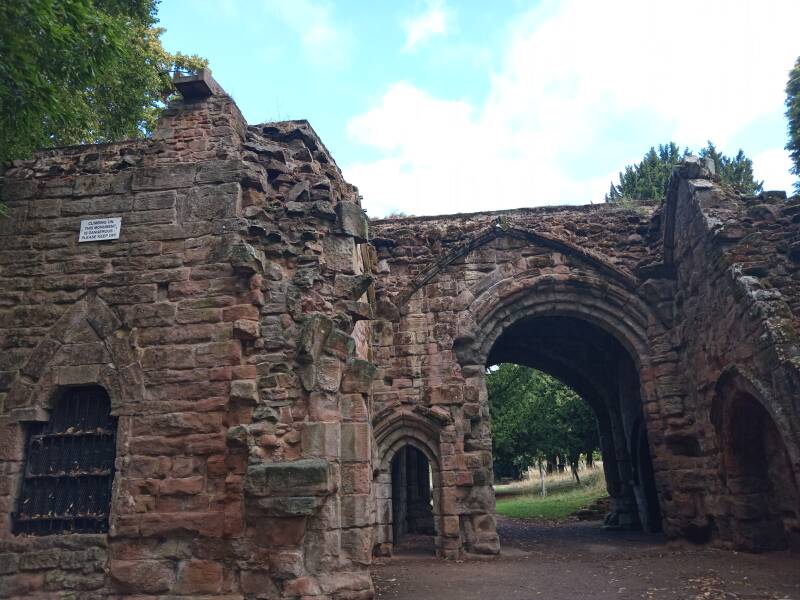
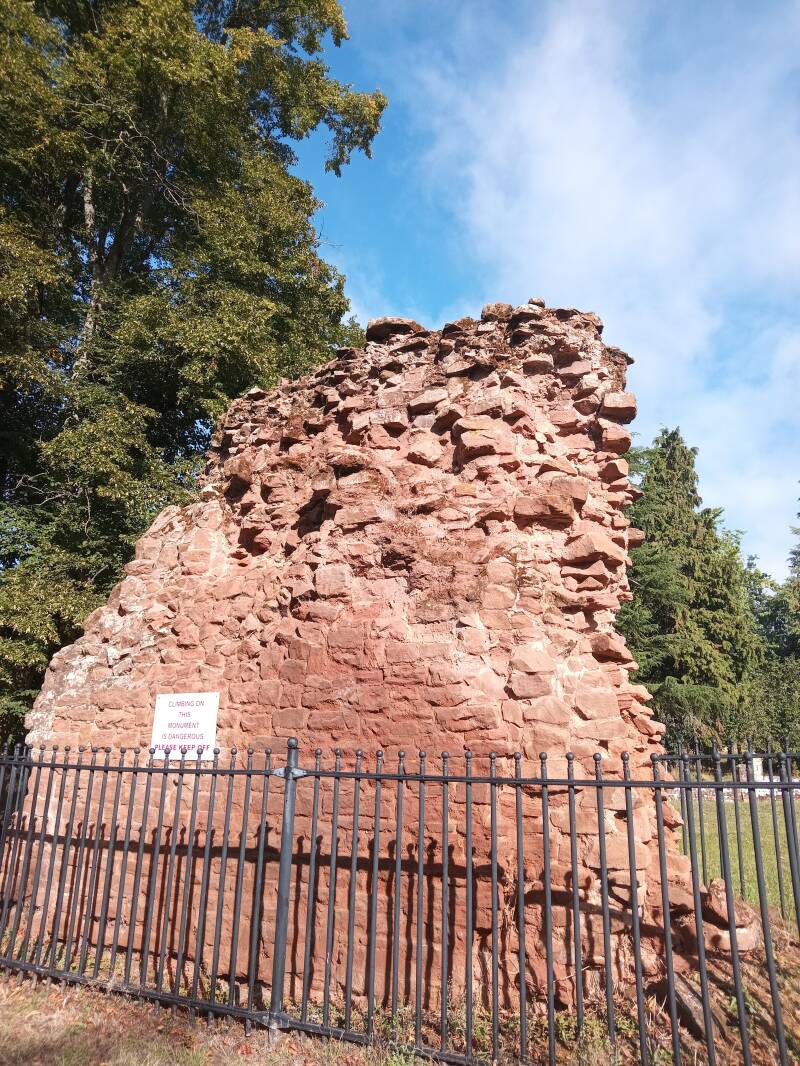
These lie in the grounds of St Nicholas' Church. Much of the original excavation has been re-interred for its own protection, but amongst the gravestones, you can still see segments of the walls of this once powerful regime.
In fact, the abbey was one of the wealthiest landowners in all the county until the end of the 15th century. At this time, people started to question the legitimacy of the abbey's wealth, and one royal divorce later, the abbey was forced to close. Some of the stones were used to build the castle. The rest just fell into ruin.
But don't feel too sorry for the canons. They were pensioned off on three times the average wage.
The remaining walls display signs saying, "Do not climb on the walls."
I really despair at humanity sometimes - shouldn't that just be obvious?
But there was something peaceful this bank holiday Monday. Down by the lake, the swans took one look at me as though sizing whether I were a threat. Deciding I wasn't, they swam gracefully away.
Kenilworth Castle


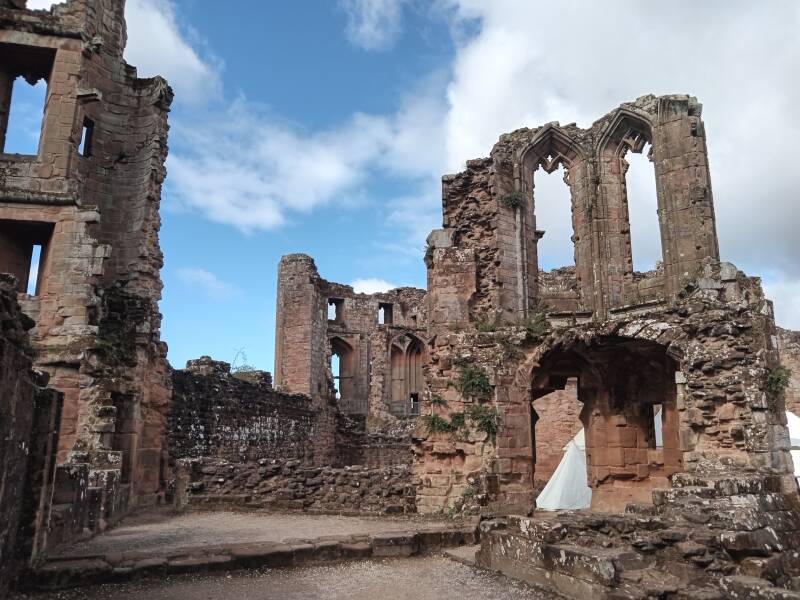
On the very edge of the town lie the ruins of Kenilworth Castle. It was here that Robert Dudley tried to lure Elizabeth Tudor into marriage. Indeed, much of the complex was built, or re-purposed, specifically for this reason.
The castle was originally built by the sheriff of Warwickshire, Geoffrey de Clinton, financed by Henry I, who did not trust Roger de Beaumont, Earl of Warwick.
A century later, this was the site of the longest siege in English history. Supporters of Simon de Monfort occupied the castle. Barrage after royalist barrage failed to penetrate the walls of the castle, but in the end, the rebels preferred to surrender than to succumb to starvation and disease.
At the age of 25, Elizabeth Tudor assumed the English throne. It was well-known across the whole of Europe that she was to be betrothed to Robert Dudley.
But there were three problems. Robert was already married, and his father had been executed from treason.
Elizabeth forgave Robert for the sins of his father, and Amy Dudley died soon afterwards. For years, there had been rumours that Robert Dudley planned to murder his wife so that he could marry the queen, and his wife's actual death did not quell these whispers.
The biggest obstacle, however, was that the queen of England should marry a European prince, not a common earl!
Robert Dudley was devoted to his queen, and she to him. Indeed, she rarely let him leave her sight, and whilst Dudley expanded the castle to accommodate his queen, he rarely had the opportunity to enjoy time on his own property.
At the end of the Wars of the Three Kingdoms (often wrongly called The English Civil War), Oliver Cromwell ordered the building to be sacked. Whilst the castle was allowed to remain standing, enough was destroyed to render it utterly useless from the defensive point of view.
Kenilworth Castle can consider itself lucky - many other castles were almost completely razed.
The popularity of the castle was revived by Sir Walter Scott, although he played hard and fast with the truth.
Despite this, the castle was in a terrible state of repair until well into the 20th century. In the 1930s, the car manufacturer Sir John Siddeley purchased the castle, restored it, and then handed it to the British state.
I've always been interested in History, and castles are living History. A chance to really see and understand life in the past, and how their stories have led to our own. I know marrying for romantic love is a relatively new fashion, but I can just imagine the encounters between Elizabeth and Dudley at their most intimate!
But also the sieges, and the destruction.
And Kenilworth Castle is set amongst some of the most beautiful countryside in England. Yes, it's not dramatic, but the rolling hills are something else.
Old Town Festival
I happened to be in Kenilworth on the weekend of their Old Town Festival.
Look, I'm not the world's most cultural guy, but culture is about how people live. When people say London doesn't have culture, I invite them to actually go to London.
There's a very unique way of living in the capital - I grew up in Luton, and I don't always understand London!
For me, the Edinburgh Festival isn't culture. It's something created by Londoners, it's very artificial, and has pretty much no impact on the host city.
A few years ago, I was on a park bench and a man walked passed and shouted, "forty-seven". A woman walked the other way and shouted, "five hundred and three". Then another woman walked passed and shouted, "twelve".
It turns out these are bus numbers to places more interesting than Scotland's capital.
By the way, I don't remember the actually numbers these people shouted at me. If you take the 47 and end up in a shit-hole, that's on you! I have absolutely no idea where Lothian Transport bus route 47 takes you, or even if it actually exists. Same goes for the 503 and the 12.
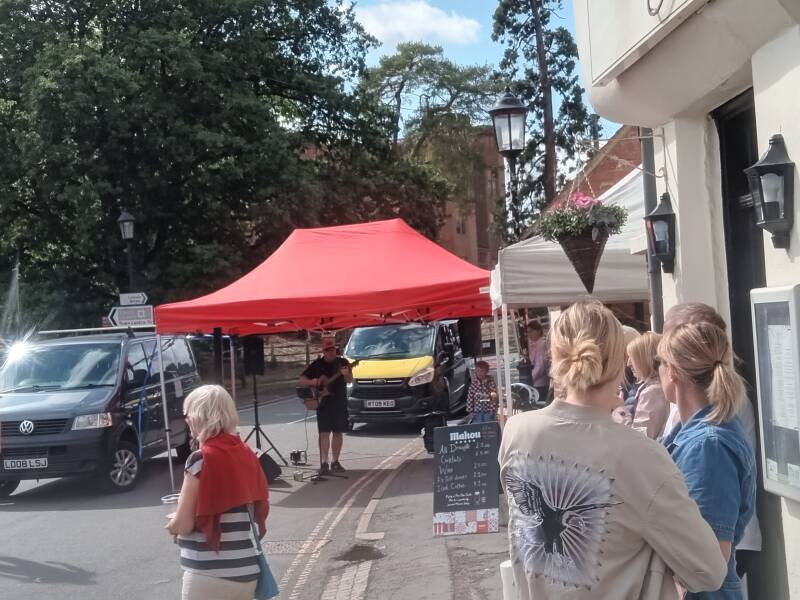
OK, it's just cover bands. But this is culture.

The Lion
I was in the gents when two men walked in. As they headed to the urinals and started unzipping their trousers, one said, "Do you remember when there were asses in the back garden?"
The other nodded. "Yeah. That was donkeys years ago!"
I'm sorry, but that it so much a better joke than pretty much anything that's been nominated for best joke at the Edinburgh Fringe in at least ten years!
But more seriously - this is town centre, and there used to be donkeys and goats running around outside. I needed to investigate.
Helen, the lady behind the bar, told me that twenty years earlier, there had just been fields at the back of the pub.
"What happened?" I asked Helen as she poured my next pint.
"Waitrose," she answered wistfully.
This is a really nice pub, but sadly, I never took any pictures of it. I'm not good at taking pictures, and I wasn't intending to write this blog. I missed some opportunities, and not photographing this pub is one of them.
Create Your Own Website With Webador